
The Everyday Working Lives project brings the hidden working lives and untold stories of Moor Pool’s past residents back to life, connecting the past with the present, and uncovering objects, research and personal stories that would otherwise remain undiscovered.
The Moor Pool Estate, built between 1907-1912, was designed as a community of homes promoting social cohesion through pleasant surroundings, recreation and well-built housing. Its history is closely tied as much to the lives of the people who lived there as to the buildings themselves.
In recent years we have used research to uncover the stories of former Moor Pool residents through exhibitions, heritage tours, the ‘People of Moor Pool’ blog series, and social media – linking untold histories to Moor Pool’s growing collection of administrative ledgers, tenant records and personal artefacts.
Greater engagement with the collection has encouraged new acquisitions and donations, reconnecting people with the everyday lives of earlier generations. Objects donated by residents range from postcards showing life on the Estate to everyday household items used by families for decades.
Last year’s Moor Pool Heritage Festival display explored the architecture of the Estate and the companies that helped build the Arts and Crafts garden suburb. Access to findmypast resources this year has enabled us to expand this research and directly connect collection objects to residents. Using census records and other sources, we have mapped how occupations changed between 1911 and 1939 and evolved over time, uncovering residents employed in industries, retail, teaching and domestic service. Here are some of the stories we have uncovered:
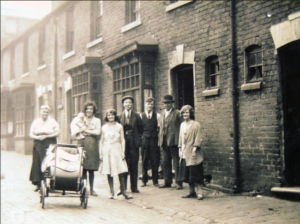
Edward John Napier Kelsey was the first baby born on the Harborne Tenants’ Estate. He was born in 1908 at 84 Park Hill Road, one of the first four houses on the Estate to have been completed. Edward was named after the local Councillor at the time, CG Napier-Clavering, whose own son, Alan Napier, would go on to become a Hollywood actor, well known as Alfred the Butler in the 1960’s Batman series.
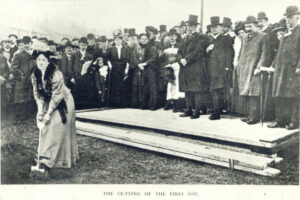
Edward’s father, Charles Kelsey, was present at the cutting of the first sod which took place on the corner of Moor Pool Avenue and Margaret Grove in October 1907, and he witnessed Margaret Nettlefold cut the first sod with the ceremonial silver spade. In 1921, Charles was working as a road ganger for the Birmingham Corporation based at the engineering depot on Rose Road.
In 1933, Edward married Dorris Perry and by 1939 they had moved to 58 Moor Pool Avenue, not far from the family home.
Edward’s older sister Ethel also stayed on the Moor Pool Estate, marrying John Ramsell in 1923 and moving to 84 Moor Pool Avenue. John worked as a motor fitter in transport repair and his daughter recalls he also joined the Home Guard (based at Moor Pool Hall) during WW2. Ethel worked at Kunzle’s confectioners on Broad Street, which was well known for its chocolates and cakes. Ethel’s daughter Shirley was born at 84 Moor Pool Avenue in 1933 and she stayed on the Estate until 1958. She would return 12 years later, moving back to the Moor Pool Estate.
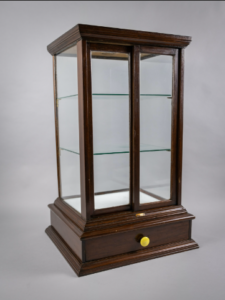
Henry William Page was one of several cabinet makers who lived on the Estate. A foreman cabinet maker for OC Hawkes cabinet and glass makers at the Globe Works on Bromsgrove Street, he was joined in the trade by his son, who worked for the company as a carpenter. Residents such as Henry and his son were part of the skilled workforce from Moor Pool that helped earn Birmingham’s reputation as the ‘City of a Thousand trades’, producing high-quality goods exported across Britain and beyond.
Bromsgrove Street in Birmingham was dominated by woodworking and supplies for trades. OC Hawkes Ltd were one of Bromsgrove Street’s largest employers and were reputed to be the largest looking-glass manufacturer in Britain. The company produced decorative cabinets, mirrors and glazed shop displays for firms including Cadbury, Fry and Rowntree, helping create the distinctive shop interiors seen across the country. As the company diversified beyond glass manufacture, it became known for innovations and patents including textured ‘crystalline’ glass for decorative door panels, and early day and night electrical illuminated retail signs.
In 1911, Henry was living at 21 Moor Pool Avenue with his wife, Florence, and their three children, who were still all living at home in 1921. By 1939, he had retired and was living with just his wife Florence.
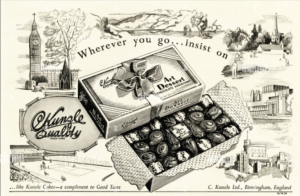
Miriam Doris Otway lived at 82 Park Hill Road with her family. By the age of 20, she was working as Forewoman for Kunzle’s confectioners in Birmingham City Centre.
C. Kunzle Ltd were high quality confectionery and cakemakers based at 156 Broad Street. Founded by Swiss chef and chocolatier Christian Kunzle, the business had grown from a small bakehouse into one of Birmingham’s best known confectioners by the 1920’s, supplying both shops and restaurants.
The family were living on the Moor Pool Estate in 1911 and Miriam’s father William was a gardener. However, by 1921 Miriam’s mother Minnie was widowed and working as Caretaker to the Moor Pool Estate’s community hall, Moor Pool Hall and club building. Miriam’s nineteen year old sister Nellie also worked for Harborne Tenant’s as a junior clerk. Seventeen year old Winifred worked as a domestic servant, and their older brother Kenneth was out of work but had worked as an engine turner at W Heale and Sons Silversmith. Their grandmother was also living in the house.
Miriam married Alfred Lane in 1926, a year after her mother passed away. By 1939, Alfred and Miriam had moved to 79 Moor Pool Avenue, and Alfred was working as a foreman tin worker.
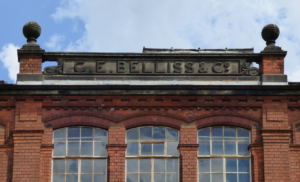
In 1921, Harry Pagett was living at 9 The Circle with his wife Gertrude. He was a draughtsman and designer for the engineering company Belliss and Morcom, based at the Ledsam Street works in Ladywood.
Belliss and Morcom employed a number of Moor Pool residents at their factories. By the time the Estate was built, the company had expanded from manufacturing steam engines into industrial air compressors and equipment for naval vessels. The factory was an easy commute from Moor Pool using the Harborne Branch railway, which connected residents to workplaces across Birmingham.
Harry spent his entire working life at Belliss and Morcom, helping design the company’s air compressors. By his retirement in 1950, he had become chief designer and head of compressor drawing.
Harry worked at the largest of their factories at the Ledsam Street works which had its own wharf next to the canal. Employment cards revealed that it actively hired and retrained those disfigured and injured during the First World War.
Harry was born in Stourbridge and when he initially started working for the company he lived in Edgbaston with his uncle in 1911. He married Gertrude in 1914 and they initially lived on Carless Avenue, before moving to 9 The Circle by 1921. Gertrude continued to live on the Estate until Harry’s death in 1951, followed by Gertude’s passing away in 1955.
Esther Savage lived at 9 Margaret Grove. She had previously worked as a dressmaker when the family lived at Vincent Street in Ladywood but by 1921 she was employed by the Birmingham Corporation as a canvasser at the Rates Office on Edmund Street. The move represented a significant move into municipal employment for a woman at the time. The 1921 census, completed by her father, shows ‘clerical’ crossed out and replaced with ‘canvasser.’ Canvassing for the rate office would have involved surveying properties, gathering and collecting data house-to-house, and documenting occupiers. The detailed reports would then be compiled in rate books, which are an important surviving source of information today for research.
Esther, her siblings and father, Robert, had all been born in Yardley, and in 1891 were living in Devon where Robert worked as a gardener. They had moved to Ladywood by 1901 and her parents moved to Moor Pool by 1911. In 1921 she was living at 9 Margaret Grove with her parents and her 70 year old father Robert who worked as a private coachman at 19 Highfield Road, one of the large Georgian houses in Edgbaston. She married in 1926 in Birmingham and by 1939, as was expected of married women at the time, reverted to unpaid domestic duties and was living in Somerset with her husband, William Diamond.
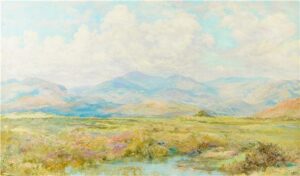
Edward Steel Harper was an artist who in 1921 worked as a teacher of drawing and painting at Wolverhampton Grammar School, later becoming the schools Art Master. He worked here for many years until his retirement in 1942.
Edward studied art at Birmingham School of Art and later became a known artist, specialising in landscapes painted in oil. His style mixed late Pre-Raphaelitism with some more modern styles and techniques to create some distinctive pieces. Much of his work is on display in public galleries, including the Birmingham Museum & Art Gallery.
Steel Harper lived in 55 Moor Pool Avenue with his wife Estelle-Marie, who was also an artist, until his death in 1951. He moved to the Estate when it was first built. His father had been a jeweller and was interested in art at an early age becoming an art teacher by his early 20’s, following in his parents footsteps as they were also art teachers.
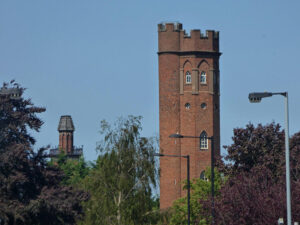
Arthur Leslie Kelley lived at 1 The Circle and was one of Birmingham’s leading meteorologists. Together with his father he played a leading role at the Edgbaston Observatory between 1917 and 1967.
The Edgbaston Observatory operated from the historic 18th century Perrott’s Folly for many years, and it was from here that local weather would be tracked and recorded from the tower.
His father, Arthur Joseph Kelley, was a science lecturer at the Midland Institute and was appointed Director of the Edgbaston Observatory in 1917. Arthur Leslie Kelley was then working as a engineering draughtsman but his father’s role sparked an interest in meteorology. He joined the Observatory as Assistant Observer in 1922 and succeeded his father as Director in 1937.
Before moving to Moor Pool the family had first lived in Bournville, where Arthur Leslie and his siblings were born, and later in Edgbaston.
Known as Rick, he pioneered the use of wireless telegraphy for weather information broadcasting and saw the scheme as a means of helping the industrial community through the study of weather. In the 1960’s he moved to the University as a lecturer helping professionalise local meteorology.
He continued to live at 1 The Circle with his wife, Lily, and daughter, Barbara, until his death in 1976.
Marion Dickinson lived at 12 The Circle and worked as a Café Manager at the New Street branch of Pattison and Co Ltd, a popular chain of café restaurants that were located throughout Birmingham city centre and its suburbs.
Marion was one of a number of residents from Moor Pool who managed a café or restaurant and also among a number of manageresses.
She lived with her brother, Augustus Morris, and her mother, Ethel Moutfort. The occupation of her mother and brother was home duties, making Marion the sole earner of the household. The family were originally from Sussex where Ethel’s husband had worked as a dental surgeon but had passed away by 1911.
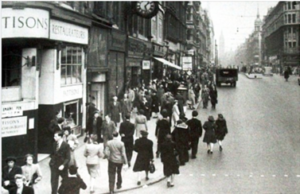
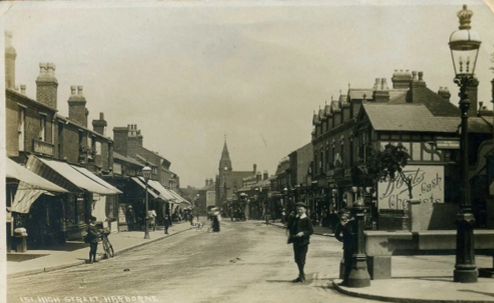
William Carr worked as a pharmacist at Boots Chemist at 196 Harborne High Street.
In 1921 he was living with his wife and two sons, aged 12 and 10. By 1939, his eldest son Kenneth was living in the family home with his wife Mary, whom he married in 1935.
Kenneth followed in his father’s footsteps and also became a pharmacist at Boots. During the Second World War he took on an additional civilian role as a First Aid Post worker for Air Raid Precautions (ARP). In this role, he would have used his expertise and medical knowledge to treat injured civilians and help manage essential medical supplies during air raids.
Boots Chemist, much like today, dispensed prescriptions as well as selling other goods from toiletries to household items. The Harborne branch where the Carr family worked was located in a small half-timbered building which still stands on Harborne High Street, near the Junction.
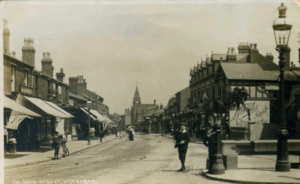
Henry Betteridge of 62 Moor Pool Avenue worked as a motor fitter for Components Ltd based in Selly Oak. He was one of a number of Moor Pool’s residents employed in Birmingham’s growing motor and cycle industries during the twentieth century.
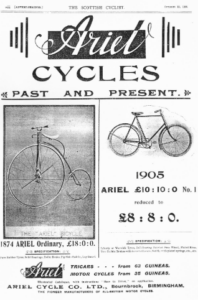
Components Ltd was a large automotive and cycling manufacturer based in Selly Oak. The company was well known for its Fleet and Ariel bicycles but also manufactured motorcycle components and complete motorbikes, where Henry is likely to have worked as a motor fitter.
The factory stood at Dale Road in Selly Oak and today the Ariel Aqueduct carries the canal across the former works, preserving the company’s connection to the area.
By the mid 1920’s the company was building their own high performance motors rather than outsourcing them. During the First World War they made military motorcycles adapting the 3.5hp single-cylinder engines for military usage. By the time of the Second World War the company had gone bankrupt but reformed as Ariel Motors that would also built military motorbikes for the war effort, as well as military folding bicycles used by airborne troops.
In 1911 he lived at 62 Moor Pool Avenue with his widowed mother and sister. By 1921 his sister had left home and his mother was 73. By 1939 she had passed away and Henry was living in the house with a lodger.
Much of the research into the working lives of Moor Pool residents working lives has been carried out using census records and other historical sources available through Find My Past. These include the 1911 and 1921 censuses and the 1939 Register.
At the time of the 1911 census the Moor Pool Estate had not yet been completed. The absence of houses on Carless Avenue and Ravenhurst Road suggests they were not yet occupied. Moor Pool Hall opened 5th November 1910 and the Estate was completed in 1912 with the final houses built up Carless Avenue. The Estate was still in its early years and several residents worked in the building trades connected to its development. More women were employed in domestic service than would be the case in 1921.
The 1921 census was taken on 19th June 1921 when Birmingham was in the midst of a post-war depression.
The records show a wide range of professions. Many residents worked in clerical and administrative roles, along with skilled artisans connected to the Estate’s Arts and Crafts ideals. Teachers, commercial travellers and factory workers were also common.
The effects of the First World War are visible in the higher proportion of widows and orphans, while many women had returned to domestic roles after wartime work. However, Moor Pool had an unusually high number of women working in professional and white collar occupations such as teaching and clerical work.
Children aged 14 and over were often in employment as errand boys or apprentices , while many houses took in boarders, particularly those headed by women, to supplement income alongside war pensions.
No census was taken 1941 due to the Second World War and the 1931 census was destroyed by fire.
The 1939 Register was created to issue identity cards. It records occupations at the outbreak of war and reveals how working life had changed since 1921. More residents were in employed in managerial, supervisory and professional roles, while a growing number of women were working outside the home.
The Register provides a valuable snapshot of the community at the outbreak of war and helps fills the gap between the 1921 and 1951 censuses.
Census records are only publicly available every 100 years so more recent information remains closed and the 1951 census will not be available until 2052.
Moor Pool’s Everyday Working Lives Project draws on census records, findmypast, archives, oral histories and personal recollections to explore the working lives of the people who once lived in the homes of the Moor Pool Estate. Inspired by stories uncovered through this research, the project traces the lives and occupations of the former residents, bringing their stories to life through objects from Moor Pool Heritage Trust’s collection.
Research and interpretation by Moor Pool Heritage Trust with additional research contributed by University of Birmingham placement students. Special thanks to India and Fay for their invaluable contributions.
With thanks to Moor Pool residents past and present who kindly shared objects, photographs and memories.
Moor Pool Hall
37 The Circle, Harborne,
Birmingham, B17 9DY
Registered Charity Number: 1148252

© 2026 All rights reserved | Website by Citrus Frog