
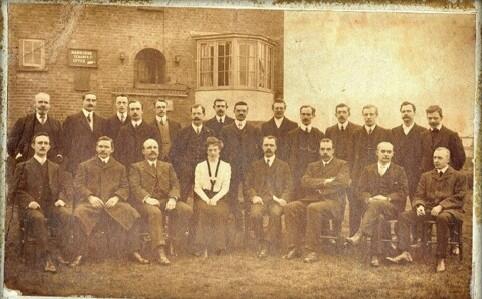
The Everyday Working Lives project brings the hidden working lives and untold stories of Moor Pool’s past residents back to life, connecting the past with the present, and uncovering objects, research and personal stories that would otherwise remain undiscovered.
When the Moor Pool Estate was built it was intentionally designed to include a social mix with residents working in a wide range of professions from manual labour to artisan trades, skilled trades and professional occupations. Census records from 1911, 1921 and the 1939 Register reveal a diverse community of teachers, clerks, craftsmen, factory workers, specialists and business owners reflecting the mix of skills that shaped Birmingham’s reputation as the ‘City of a Thousand Trades.’
Below are just some of the stories we have uncovered. For more, please go to Part One.
Selina Clarke is a fascinating example of an independent, professional woman who remained unmarried at a time where many women relied on their husband’s earnings for security. However, she never lived alone, and seemed to become a part of her sister’s family unit in the latter half of her life.
She was born in Birmingham in 1871 and was named after her mother, who died during her childhood. After which, she lived with her father, her stepmother and several stepsiblings from a previous marriage. She worked as a ‘warehouse girl’ when she was 19 years old, as did three of her stepsisters.
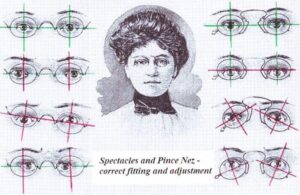
In 1911, she lived as a boarder in an older couple’s house and was ‘manageress’ for an Optician. She had moved by 1921 to live with her married sister, Caroline Booth, and her husband, Albert Edward Booth, at 7 High Brow on the Moor Pool Estate. From there, she continued to work as a self-employed Optician at 27 Hagley Road.
By 1931, Selina Clarke and the Booths had moved to another house in Moor Pool – 87 Ravenhurst Road. She lived there until her death in 1937, with her brother-in-law being granted the right to manage her estate.
Written by Clementine Birnie, University of Birmingham placement student
Alfred Hare worked as Assistant Chief Timetable and Passenger Clerk for London and North Western Railway (LNWR), based at New Street Station. In 1921, Alfred lived at 44 Moor Pool Avenue with his wife and their three children.
His daughter, Cecilia, worked at the goods department at Curzon Street, while 19 year-old Dorothy worked as a Cashier at New Street Station. Their younger brother, Edward (aged 17), worked closer to home as a Booking Clerk in the passenger department at Harborne Station. The children had all been born in Tipton, where the family had previously lived.
The family may have used the Harborne branch railway to travel to work. Operated by LNWR, the branch connected Harborne with Birmingham’s wider railway network. Curzon Street Station, where Cecilia worked, had closed to passengers in 1893 but continued handling railway freight until 1966. Its Grade I listed entrance building survives and forms part of the wider HS2 Curzon Street development. New Street Station, where Alfred and Dorothy worked, opened in the 1850’s and had taken over much of the city’s passenger traffic.
The LNWR operated from 1846 to 1922 and was nicknamed ‘The Premier Line.’ It became part of the London, Midland and Scotland Railway in 1923. Although the Harborne branch eventually closed, much of the former LNWR network remains in use today.
By 1939, Alfred had retired and was widowed, but was still living at 44 Moor Pool Avenue with his daughter, Dorothy, and son-in-law, Charles Knott. Edward had married Hilda Darby in 1934 and moved to 22 the Circle, remaining on the Estate and continuing to work for the railway as a clerk.
Sisters Maggie and Louisa were three years apart in age and lived with their father, William, at 7 Wentworth Gate at the time of the 1921 census. They had previously lived at other Harborne addresses, including nearby 16 Rose Road, Serpentine Road and Greenfield Road. They came from a large family of eight siblings. Their father had been a chandelier maker and Maggie had been working as a jeweller’s warehouse girl at the age of 15, before starting work at nearby Bournville.
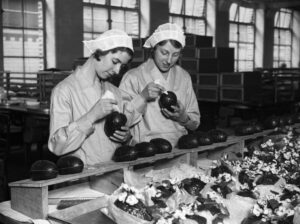
Both sisters worked as chocolate makers at the Cadbury Brothers Bournville factory, which was also founded on garden suburb principles, and employed a number of residents on the Estate.
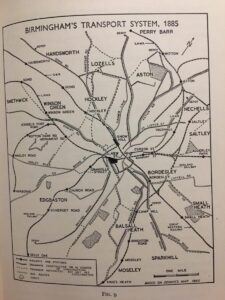
By 1926, they would have been able to travel on the Outer Circle Bus Route 11, which would have been a direct link from Harborne to Bournville.
Both sisters were employed by Cadbury for most of their working lives and were still living together in retirement at 7 Wentworth Gate by 1939. They were still living at the property in the 1950’s when Maggie was working from home as a corsetiere in her 70’s.
The Williams family lived at 61 Carless Avenue in 1921. Rowland James Williams was a Chartered Accountant and General Manager for John Smith Ltd, a steel wire manufacturer at Mitre Mills, Richard Street.
John Smith Ltd had started in 1873 initially making buckle tongs, before expanding into wire-drawing mills and pressed metal stamping at its original Salford Works.
Rowland Williams married John Smith’s daughter, Elizabeth Pamela. Following John Smith’s death in 1929, Rowland became the Managing Director, with his son, Eric, later following him into the business. The company continued until 1978.
Rowland and Elizabeth lived at 61 Carless Avenue with their sons, Eric and Maxwell, daughter Kathleen, and their cook, Mary Cosgrave. They had previously lived on the Estate at 104 Ravenhurst Road where they also had a domestic servant, Elsie Webb. Elizabeth’s brother, John Sidney Smith, was also living with them at the time, working as a Commercial Traveller, which was an occupation shared by many Moor Pool residents. John Sidney’s great grandson, James Powell, would go on to run Robert Powell Estate Agents, established by his father.
The Harborne Tenants’ ledgers record that the Williams family had moved to 61 Carless Avenue by 1912 and remained there until 1932. By 1939 they had left Moor Pool and were living in 37 Farquhar Road.
The family’s connections with Birmingham continued through later generations. Rowland Williams’ granddaughter, Sue Behan, would go on to promote the city through the Big Brum Buz open top bus tour around Birmingham in the 2010’s.
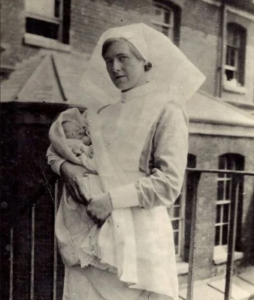
Lily Maud Turnbridge was a Certified Midwife and worked as a maternity nurse. She had moved from Stafford, where she was born and had been working as an assistant housekeeper in Cannock at the time of the 1911 census. By 1921, she had moved to 20 North Gate where she lived alone and worked as a Certified Midwife with no fixed place of work, as she would have attended residents’ homes. Midwives of this period had very little time off work and would have worked long hours as and when required.
Following the legal recognition of midwifery in 1902, training and certification became compulsory for all midwives. There were several training centres in Birmingham, and Lily’s closest would have been Birmingham Union Infirmary at Selly Oak. Under the new act, newly registered midwives had to carry out three months training which had increased to six months in 1916 and 12 months by 1926. Lily would have delivered many babies born on the Estate at their homes during this period.
By 1926, she had married James Sawyer, a lime merchant who had been staying at nearby Wentworth Road in 1921. They both continued to live at 20 North Gate until Lily passed away in 1933. She left around £209 in her will.
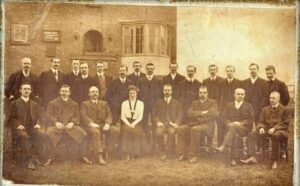
George Frost lived at 40 Moor Pool Avenue and worked as a Municipal Clerk for the City of Birmingham Water Department.
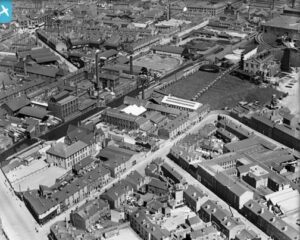
The City of Birmingham Water Department was based at Waterworks Road, Edgbaston, beside Edgbaston Reservoir and still stands today. Birmingham’s water supply has been brought from the Elan Valley since 1906. George worked as a timekeeper in 1911 and by 1939 he had progressed to Chief Corporation Clerk. He cycled to Edgbaston every day.
Outside work, George played an active role in Estate life. He served on the Estate’s first Residents’ Council, belonged to both the Bowling and Skittle Clubs and later led the residents’ opposition to buying out Harborne Tenants in the 1950’s.
George lived with his wife, Lilian, and their two sons, George and Leslie. The family moved from Ladywood to the newly built Moor Pool Estate in 1908, and watched their house being built. George and Lilian remained at 40 Moor Pool Avenue for the rest of their lives.
Their younger son, Leslie, grew up with Pam Burrows, who lived nearby at 85 Moor Pool Avenue. They married in 1941 and their son, Mike Frost, was born on the Estate in 1947.
Like his father and grandfather, Mike became an active Skittle Club and Moor Pool Residents’ Association member. Known as ‘Major Mustard’, he has entertained local children with his puppet shows as a touring solo puppeteer and storyteller.
Mike has lived at four different Moor Pool addresses throughout his life before moving to 1 Carless Avenue, and continues to be a very active Skittle Club member.
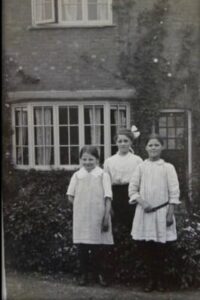
Frederick Lowe was one of six siblings living at 14 Moor Pool Avenue in 1921. He was an out of work motor mechanic at the time but had trained as a master toolmaker at Austin Motors in Longbridge before working for Pattison’s bakery after WWI, maintaining their fleet of delivery vehicles. He had fought as a dispatch rider during the war, passing messages between camps in Khyber, Mesopotamia and North Africa.
His father was working for John Marstons Motor and Carriage Trimmers at the time and was a keen bowler at the Moor Pool Bowls Club. Frederick’s older brother, Charles Thomas, was an engineering student and would emigrate to Australia in the 1920’s. Meanwhile, younger brother Ernest was a painter improver for Harborne Tenants, working on the houses on the Estate, and Alfred was a gardener who also worked at the Circle shop with the Birch family.
Frederick Lowe married Charlotte Broadhurst, who also grew up on the Estate, and they moved out of 14 Moor Pool Avenue for a time before moving back during the Second World War with their baby daughter Sylvia, to keep their mother, Sarah, company.
During the Second World War, Frederick was a warden for the Incendiary Watch and was said to have done top secret work at home, making components on a lathe for the Spitfire’s cockpit instruments. The equipment was under the stairs at 14 Moor Pool Avenue and used to make the house lights flicker.
The family had moved to Moor Pool in 1908 and continued to live there until 1962, when Frederick passed away. His daughter, Sylvia, moved to 28 Moor Pool Avenue to marry Fred Hanson in the 1950’s and then to 17 Moor Pool Avenue in 1974. Their daughter, Sarah, still lives on the Moor Pool Estate today with her family.
Thomas Elvins was working as an engineer’s pattern maker in 1911 for his father-in-law’s boot and shoe making company. By 1921 he was working as an artificial limb maker for Anderson & Whitelaw Ltd, making artificial limbs in leather and wood. Anderson & Whitelaw Ltd artificial limb makers were based in Balsall Heath Road. They specialized in the making of artificial arms for those who had lost them during the war, and were operating until 1922.
Not long after this in 1922, Thomas would set up his own company with a partner, making artificial limbs at premises in Granville Street off Broad Street.
In 1921 he lived with his wife Kate and their two children, Connie and John. Thomas passed away in 1924. John continued to live there until he married in 1951, at which point his sister, Connie, and her family moved to 1 Moor Pool Avenue. He would later move to 6 Wentworth Gate.
During World War II, John worked for a factory in Cofton Hackett making planes and also joined the Home Guard, which was based at Moor Pool Hall. His daughter, Tina, recalls that “he used to talk about being stationed on the top of St Peter’s church tower with a wooden rifle!” He would then go on to join the RAF ground crew before being sent to Germany at the end of the war to collect and repair grounded planes.
John had been apprenticed at his cousin’s well-known building firm, Thomas Elvins & Sons. He would go on to set up his own iron and steel fabrication firm, Harvey Ironworks, around 1954. Some of the iron gates he made can still be seen at 4 and 6 Wentworth Gate, and some posts at the back of 60 Margaret Grove.
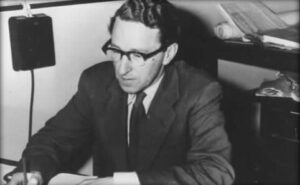
In 1921, Leonard Strudwick was working as an elementary teacher at St Peter’s Church of England School, one of the oldest schools in the area. He was one of many teachers who lived on the Moor Pool Estate.
He lived at 4 Wentworth Gate with his wife, Jessie, and their son, Leon. The family remained in the house into the 1950’s.
Their neighbour, Tina Hackett of 6 Wentworth Gate, later recalled visiting the Strudwick household as a child. She remembered spending time in their garden learning about flowers and occasionally joining them indoors for tea “where there was an amazing selection of beautiful antique furniture and ornaments.”
Mr Strudwick would sometimes give Tina books for Christmas. A stuffed black cat, probably Victorian, was given to Tina by Mrs Strudwick when she was seven years old and is now part of Moor Pool Heritage Trust’s collection.
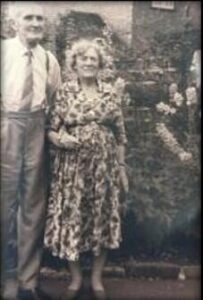
Stephen Saunders and his wife, Hannah, originally lived at 5 North Gate. They moved to Moor Pool from Bearwood. Hannah’s brother already lived on part of the Estate that had been built earlier. The family moved to the end house at 1 North Gate when it became vacant in 1912, previously occupied by a bricklayer working on the building of the Estate.
Stephen was a postman at Edgbaston Post Office and would go on to become Head Postmaster. By 1939 he was working as Inspector of Postmen.
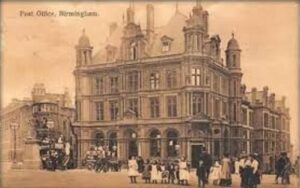
The General Post Office was based at Victoria Square, built in 1890 and still stands today. The building was used as the Head Post Office for over 80 years until it outgrew the building and moved to what is now the Mailbox in the 1980’s.
Stephen and Hannah’s daughter, Evelyn Mary Saunders, was born at 1 North Gate in 1918. In 1939 she was working as a shorthand typist.
She recalled that ‘‘my mother said they came here and first they lived at number 5 [North Gate]. My mother said it was much bigger, you got a lot more room and she did not like number 1, it was so small. Anyway they moved here into this house in 1912.”
The family had planned to move away when Stephen retired but when he passed away his wife and daughter stayed on at Moor Pool. Mary Saunders would continue to live there until 2016. When she passed away, a large number of her belongings were donated to Moor Pool Heritage Trust and are now part of the collection.
Moor Pool’s Everyday Working Lives Project draws on census records, findmypast, archives, oral histories and personal recollections to explore the working lives of the people who once lived in the homes of the Moor Pool Estate. Inspired by stories uncovered through this research, the project traces the lives and occupations of the former residents, bringing their stories to life through objects from Moor Pool Heritage Trust’s collection.
Research and interpretation by Moor Pool Heritage Trust with additional research contributed by University of Birmingham placement students. Special thanks to India, Fay and Clementine for their invaluable contributions.
With thanks to Moor Pool residents past and present who kindly shared objects, photographs and memories.
Moor Pool Hall
37 The Circle, Harborne,
Birmingham, B17 9DY
Registered Charity Number: 1148252

© 2026 All rights reserved | Website by Citrus Frog